MBTI vs Big Five: Which Personality Test Is More Accurate?
MBTI and the Big Five compared honestly: what each model measures, what retest studies find, whether results predict anything, and which test fits your goal.
If you want the short answer: for measuring personality, the Big Five is the more accurate of the two. Its scores are stable over years, they predict real-world outcomes, and they are the standard instrument in personality research. The MBTI is better thought of as a shared language — memorable, fun to talk with, but built on either/or choices that the evidence doesn't support: about half of people come back with a different letter when they retake it within weeks. Which test you should take depends on which of those two jobs you're hiring it to do. Here's the full comparison, with the studies.
What the MBTI actually measures
The Myers–Briggs Type Indicator grew out of Carl Jung's Psychological Types (1921). Katharine Cook Briggs and her daughter Isabel Briggs Myers turned Jung's theory into a questionnaire in the 1940s, and millions of people have taken some version of it since.
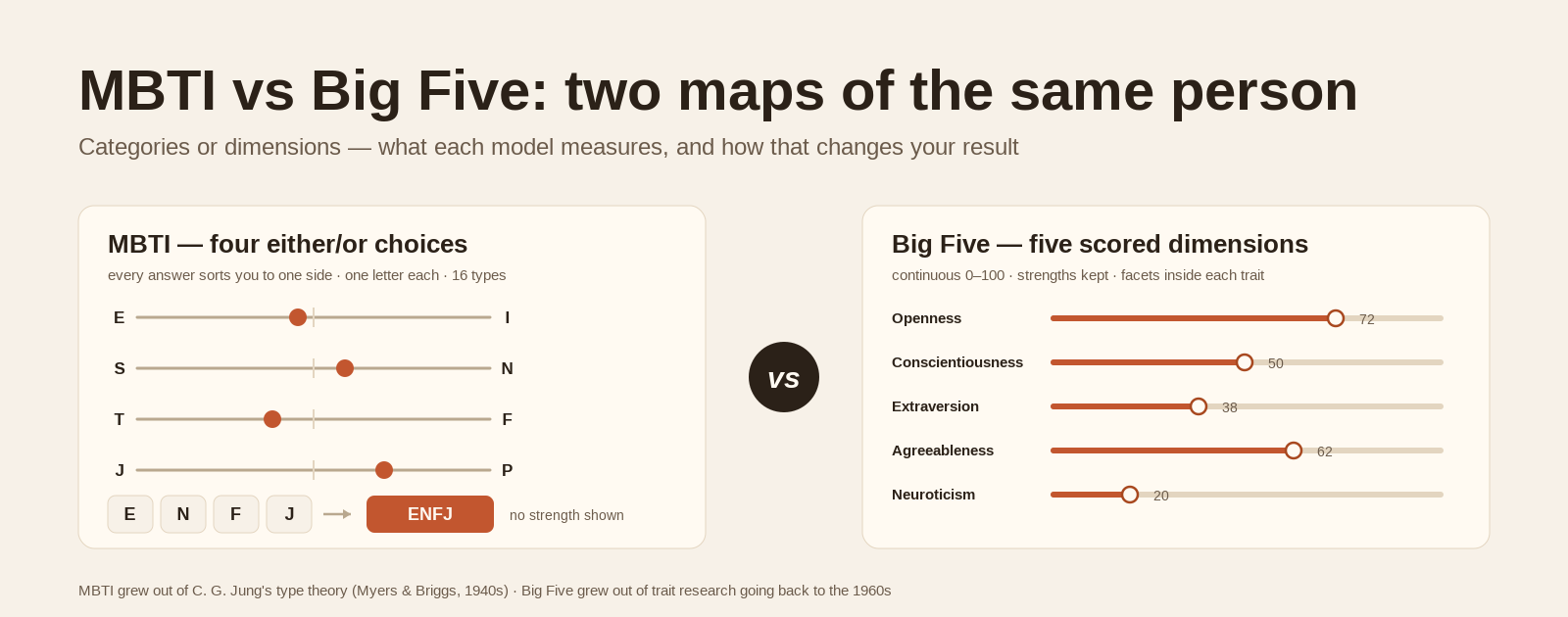
The MBTI sorts every answer into one of four either/or preferences:
- E or I — Extraversion or Introversion: where your attention and energy point
- S or N — Sensing or Intuition: how you take in information
- T or F — Thinking or Feeling: how you make decisions
- J or P — Judging or Perceiving: how you deal with the outside world
One letter per preference, four letters total: 16 types, from ISTJ to ENFP. Your result is an identity, not a profile — the instrument doesn't tell you how strong each preference is, or where you sit between the poles. That design choice is the root of almost every accuracy debate that follows.
What the Big Five actually measures
The Big Five came from a different tradition: researchers ranking thousands of trait words, collecting self-descriptions, and running them through factor analysis — work that consolidated in the early 1960s (Tupes and Christal) and became the field's standard model by the 1990s. The five broad dimensions, remembered as OCEAN:
- Openness to Experience — curiosity, imagination, appetite for the new
- Conscientiousness — organization, dependability, follow-through
- Extraversion — sociability, energy, assertiveness
- Agreeableness — warmth, cooperation, trust
- Neuroticism — the tendency toward anxiety, moodiness, emotional reactivity
There are no types here. You get a score on each dimension, and full instruments break each dimension into finer facets — for example, six facets sit inside each trait of the NEO questionnaires. You're not an anything: you're a profile of five numbers, each with a strength.
Types or scores: the real difference
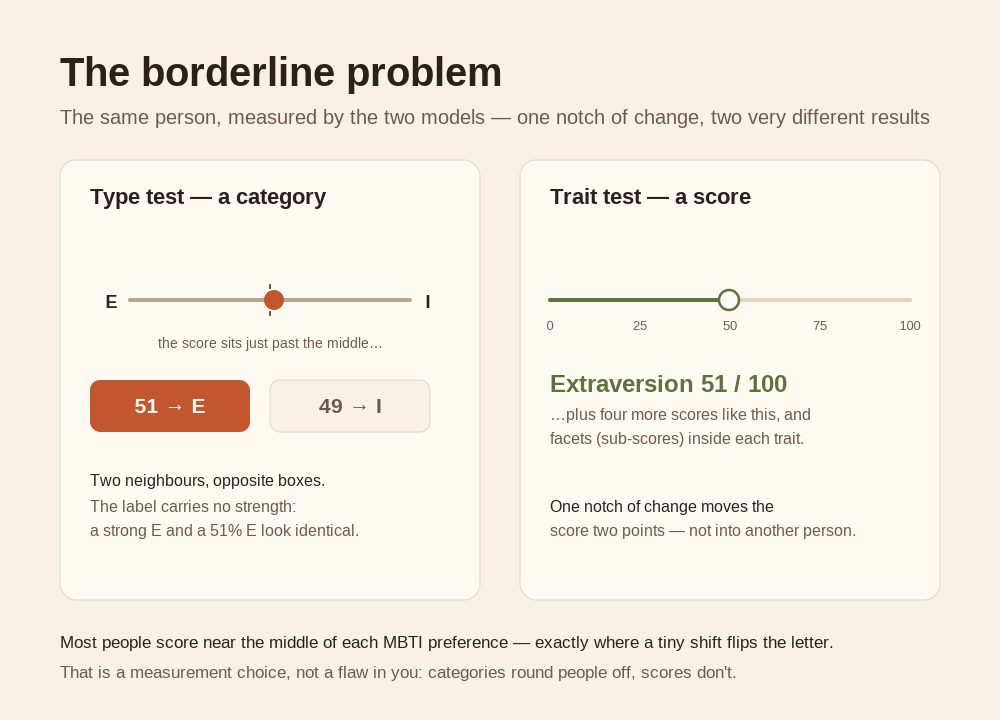
Here is the practical consequence of that design difference. Most people answer MBTI items in a way that lands them near the middle of each preference scale, not at the poles. But the MBTI has to put that middle person somewhere: a 51-vs-49 split on the Extraversion items becomes the letter E, and the strength disappears. Someone who scored 51 and someone who scored 90 get the same box.
That's why so many people feel their type is simultaneously right and wrong. The label captures a real pattern, but it throws away exactly the information that would say how well the label fits. Scores don't have this problem: move one answer and a Big Five score shifts a couple of points, rather than flipping you into an opposite category.
What retest studies find
Reliability — do you get the same result twice? — is where the two models diverge most.
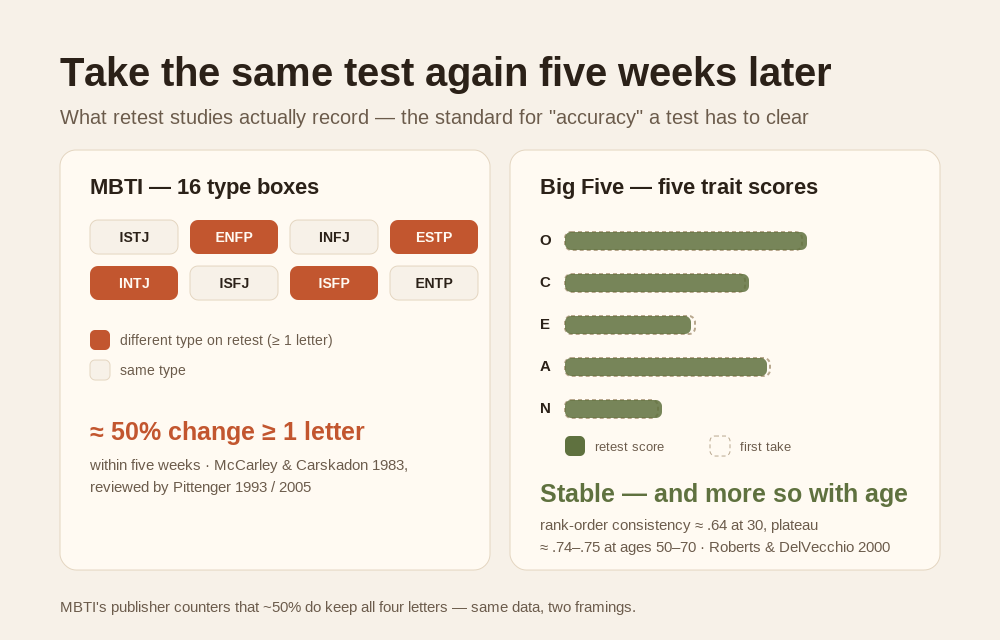
For the MBTI, the classic finding dates to McCarley and Carskadon (1983) and was reviewed by David Pittenger (1993, Review of Educational Research; extended in 2005): when people retook the test about five weeks later, roughly half came back with a different type on at least one of the four letters. The publisher's rebuttal makes the same point from the other direction: judged at the level of preference scores, the MBTI is acceptably reliable, and about half of people do keep all four letters. Both statements describe the same data — they just frame where the bar should sit. For a test whose whole output is the four letters, flipping half the letters in five weeks is hard to call accurate.
For the Big Five, the equivalent question is how stable trait scores are over time. A meta-analysis by Roberts and DelVecchio (2000, Psychology and Aging) combined 152 longitudinal studies: rank-order consistency climbs from around .64 at age 30 to a plateau of roughly .74–.75 between ages 50 and 70. Short-interval retests of full Big Five instruments routinely land above that — the scores drift a few points, which is normal, not another person.
And validity: do the results predict anything?
Reliability says the number is reproducible; validity asks whether it means anything. Here the strongest evidence again sits with the Big Five. Barrick and Mount's 1991 meta-analysis (Personnel Psychology) found Conscientiousness predicted job performance consistently across every occupational group they examined, and Conscientiousness remains the most robust personality predictor in hiring research. Big Five traits also appear throughout health and longevity studies as measurable, replicable variables.
What about the MBTI? The most-cited comparison is McCrae and Costa (1989, Journal of Personality), who correlated MBTI scores with Big Five measures in over 450 adults. The four MBTI indices mapped onto four of the five domains — E–I onto Extraversion and S–N onto Openness with correlations around .7, T–F onto Agreeableness and J–P onto Conscientiousness around .45 — and no MBTI index corresponded to Neuroticism at all. Read that two ways: the MBTI is tapping much of the same underlying trait space (its fans are right about that), but it dichotomizes that space into letters and misses a whole domain (its critics are right about that). The models are cousins, not rivals — one is a vocabulary built on the other's measurements.
So which test is more accurate?
"Accurate" bundles two questions — is the result stable? and does it predict anything? — and on both, the research record favors the Big Five:
| MBTI-style tests | Big Five tests | |
|---|---|---|
| Model | 4 dichotomies → 16 types | 5 continuous traits, plus facets |
| Result | one letter per preference, strength hidden | a 0–100-style score per trait, strength kept |
| Retest | ≈ 50% change ≥ 1 letter within 5 weeks | drift of a few points; stability ≈ .75 by midlife |
| Predictive evidence | limited; overlaps 4 of the 5 Big Five traits | extensive — job performance, health, behavior |
| Best used as | shared vocabulary, reflection prompt | measurement and self-tracking |
| Research standing | popular typology tradition | the standard model of trait psychology |
So the honest verdict: for measurement, Big Five; for conversation, MBTI does the job it was designed for. Neither result is a verdict on who you are — every questionnaire is a snapshot with error bars, and you are the thing being measured, not the number.
Which one should you actually take?
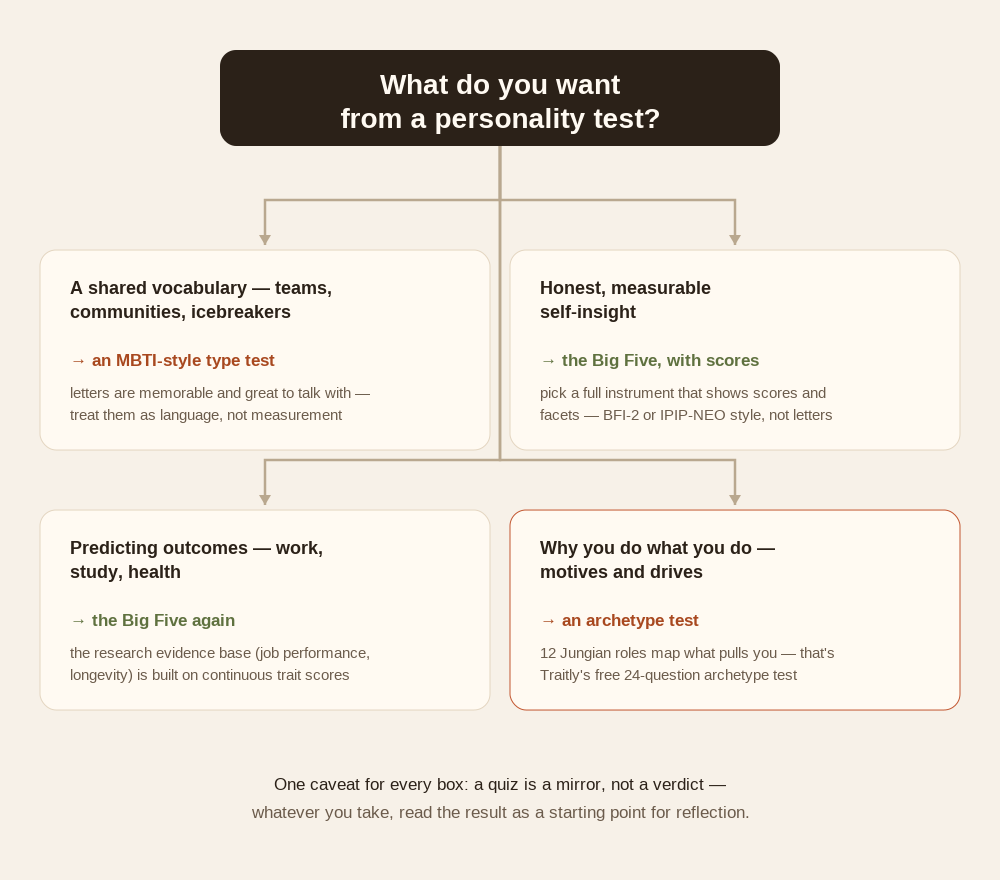
If you want the Big Five with real scores, take a full instrument rather than a 10-item teaser: the BFI-2 and IPIP-NEO–style tests report domain and facet scores free — our roundup of free 16Personalities alternatives lists the verified options with question counts and sign-up quirks. If you want a free four-letter-style test for the vocabulary, the OEJTS is the closest free match to the classic format. And if your real question is why you do what you do — not how your thinking sorts into letters or where your traits sit — that's a different job again, and the tool at the bottom of this page is built for it.
Where Traitly fits: archetypes, not letters
Traitly takes its cue from the same source the MBTI came from — Jung's type theory — but draws a different map. Instead of sorting you into one of 16 four-letter boxes, our 24-question archetype test reads your answers across 12 Jungian archetypes (grouped into four families: the Ego imprint, the Order structures, the Social bonds, and the Freedom drives) and shows you a dominant archetype plus your full distribution across all twelve — so you see the strength of each pull, the thing a type label hides. To be clear about what it is: archetypes are a lens for reflection and self-understanding, not a psychometric instrument like the Big Five, and we don't pretend otherwise. Take it for free, in about three minutes, no signup: start the archetype test.
Sources
- McCrae, R. R., & Costa, P. T. (1989). Reinterpreting the Myers-Briggs Type Indicator from the perspective of the five-factor model of personality. Journal of Personality, 57, 17–40.
- Pittenger, D. J. (1993, Review of Educational Research) reviewed the MBTI's retest record, including the McCarley & Carskadon (1983) five-week finding cited throughout the reliability literature; his 2005 follow-up, "Cautionary comments regarding the Myers-Briggs Type Indicator", extends the critique.
- Roberts, B. W., & DelVecchio, W. F. (2000). The rank-order consistency of personality traits from childhood to old age. Psychology and Aging, 15(1), 3–23.
- Barrick, M. R., & Mount, M. K. (1991). The Big Five personality dimensions and job performance: A meta-analysis. Personnel Psychology, 44(1), 1–26.
Frequently asked questions
Is the Big Five more valid than the MBTI?
For measurement, yes. Big Five scores show stronger retest stability and are behind most of the predictive research on personality — job performance, health, behavior. The MBTI still overlaps with four of the five Big Five domains (McCrae & Costa, 1989), so it isn't meaningless — it's a rescaled, either/or version of similar traits, best used as vocabulary rather than measurement.
Why do I get a different MBTI type every time I take it?
Because your answers probably sit near the middle of each preference scale, and the MBTI forces a single letter on that middle zone — a 51/49 split becomes a whole letter. Retest studies found roughly half of people change at least one letter within five weeks (McCarley & Carskadon, 1983; reviewed by Pittenger). If your results flip, that's information: take a scored Big Five test to see your actual position instead of a rounded category.
Can MBTI types be converted into Big Five scores?
Only roughly. Research correlations map E–I onto Extraversion, S–N onto Openness, T–F onto Agreeableness, and J–P onto Conscientiousness (around .7 for the first two pairs, around .45 for the others), but the MBTI covers nothing for Neuroticism and hides score strength — so a conversion is an approximation, not an equivalent. The two models share roots, not resolution.