7 Free 16Personalities Alternatives, Verified (2026)
Compare 7 free 16Personalities alternatives with verified facts — question counts, what's really free, sign-up rules, and result depth for each.
If you're looking for a 16Personalities alternative, here's the short answer: the closest free substitutes are Open Psychometrics' OEJTS (60 items, no account, same four-letter style), HumanMetrics' Jung Typology Test (72 yes/no questions, no registration), and IDRlabs' 44-question test. If you want actual numbers instead of letters, bigfive-test.com scores the Big Five free in about 10 minutes. And if what you really want is to understand why you do what you do — not just how your thinking sorts into letters — the 24-question archetype test on this site maps your motivations instead.
Every fact below was checked against each test's own live site in November 2026: question counts, what's actually free, where you get asked to sign up, and what your result looks like. Competitor roundups circulate stale numbers (we caught two ourselves while researching); this table is the corrected version.
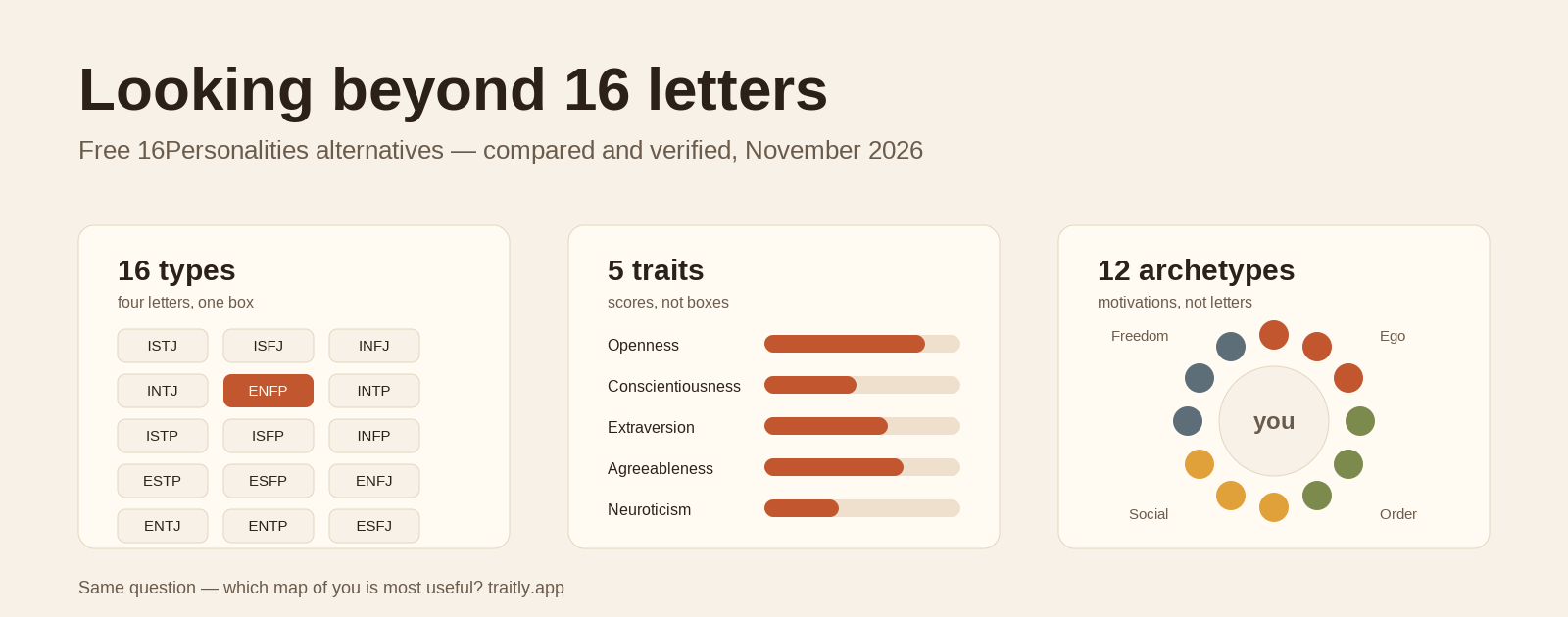
Why people look for a 16Personalities alternative
16Personalities is free, polished, and genuinely good at what it does — so why look elsewhere? Three reasons come up again and again:
- The upsell funnel. The test and your basic profile are free, but the result page leads with paid premium profiles. Some people just want the answer without the sales page.
- Letter fatigue. Four-letter types are a great shared vocabulary, but they round you off: answer one question differently and you flip from one box to its opposite. Plenty of people want scores they can actually reason with.
- A different question entirely. 16Personalities describes how you think and act. Some testers want to know why — what motivates them — or want a framework with stronger research backing.
(The official MBTI, for comparison, typically costs around $50 or more and is usually administered through a certified practitioner — which is exactly why free tests like 16Personalities and the alternatives below took over the internet.)
The verified comparison table
| Test | Framework | Length | What's free | Sign-up? | Result depth | Best for |
|---|---|---|---|---|---|---|
| 16Personalities | Own model — Big Five-style traits read as 16 types | ~60 statements · ~10 min | Full test + basic type profile | Optional — to save results | Detailed free type page; premium profiles paid | The classic experience, polished |
| Open Psychometrics (OEJTS) | Jungian 4-letter type, open source | 60 items · 5–7 min | Everything | None | Type + preference strengths | Closest free substitute |
| HumanMetrics JTT | Jung / MBTI 16 types | 72 yes/no · ~5 min | Everything | None | Type + strengths + careers + famous types | Richest free read among 16-type tests |
| IDRlabs | 16 types | 44 questions | 4-letter result | None | Type + short profile | Speed |
| Truity TypeFinder | MBTI-style — 4 dimensions, 23 facets | 130 questions · 10–15 min | Brief report | Optional account | Full report paid | The most thorough questionnaire |
| bigfive-test.com | Big Five (IPIP-NEO) — 5 traits, 30 facets | 120 items · ~10 min | Everything | None | Percentile scores for all 30 facets | Real measurement |
| Crystal | DISC (behavioral) | Not published | The test | Account required to see results | DISC profile; premium extras paid | Work and team contexts |
| Traitly | Jungian 12 archetypes | 24 questions · ~3 min | Everything | None | Leading archetype + full 12-archetype profile + guides | Motivation, fast |
Checked against each provider's live site on November 24, 2026. Prices and features change — the linked pages below are the source of truth.
The alternatives, one by one
Open Psychometrics' OEJTS — the closest free match
The Open Extended Jungian Type Scales is a 60-item open-source test: a first section of paired opposite descriptors rated on a five-point scale, a second of first-person statements. It takes about 5–7 minutes and reports the same E/I, S/N, T/F, J/P letters as 16Personalities — instantly, with no account. What it doesn't give you is polish: the result is a plain type readout with preference strengths, and there's no long-form profile to keep reading afterwards. It's run by researchers rather than a company, and there's no upsell anywhere.
HumanMetrics' Jung Typology Test — the veteran
HumanMetrics has served its Jung Typology Test for decades: 72 yes/no questions, about 5 minutes, no registration to see your result. The result is surprisingly rich for a free test — your four-letter type, preference strengths in percent, a type description, communication and learning styles, behavior under stress, and even career suggestions and famous people who share your type. The site design is very much from another era, but the test is so widely used that published research has employed it as an instrument.
IDRlabs' Jung and Briggs-Myers test — the quick one
IDRlabs asks just 44 questions and returns your four-letter type free, with no sign-up step. It's the shortest of the 16-type options here — a good first look, and the thinnest result: a type and a short profile rather than a deep dive. IDRlabs also hosts dozens of other self-tests if you want to keep exploring afterwards.
Truity's TypeFinder — the thorough one
Truity's TypeFinder is the longest questionnaire on this list: about 130 questions measuring four dimensions and 23 facets, 10–15 minutes. The brief report — the key points of your result — is free to view without registration, and an optional account saves your progress and results. The full expanded report costs money. If 16Personalities feels too quick and you want a serious, career-oriented read, this is the deep version of the same idea.
bigfive-test.com — the scientific option
bigfive-test.com runs the IPIP-NEO: 120 items drawn from the International Personality Item Pool, the public-domain item bank that academic researchers actually use. Free, no sign-up, about 10 minutes, open source. Instead of one of 16 labels you get percentile scores on the five major traits — openness, conscientiousness, extraversion, agreeableness, neuroticism — plus 30 underlying facets. The trade-off is that it tells you how much of each trait you carry, not which character you're playing.
Crystal — the workplace one
Crystal's assessment is DISC-based: how you approach problems, influence others, respond to pace, and handle procedures. The test is free, but results are tied to the free account you create when you finish — you can't see your profile without signing up — and premium features like full PDF reports and retakes run on a subscription. It's built for professional profiles, sales, and team contexts rather than self-reflection.
Traitly — the motivation-first one (that's us)
Traitly asks a different question. Instead of 16 thinking styles, it maps which of Jung's 12 archetypes leads your personality — the role you instinctively play in your own story. The archetype test is 24 questions, about 3 minutes: free, no sign-up, instant result, scored entirely in your browser, nothing uploaded. You get your leading archetype, a full distribution across all twelve, and a deep-dive guide for each — the Sage is a good example of what those look like. If you'd rather measure where you sit on coldness, empathy, and impulsivity, the psychopath test works the same way in about 4 minutes. And we'll say it plainly: archetypes are a self-reflection lens, not a validated psychometric — more on that below.
Cognitive-function deep cuts, for the enthusiasts
If you've outgrown letter dichotomies entirely, two long-standing community favorites explore Jung's cognitive functions instead of types: keys2cognition and Sakinorva. These are rougher around the edges and aimed at people who already know what "Ni" and "Fe" mean — but they're free, and they go deeper into theory than any mainstream test on this list.
A decision map: which test fits your goal
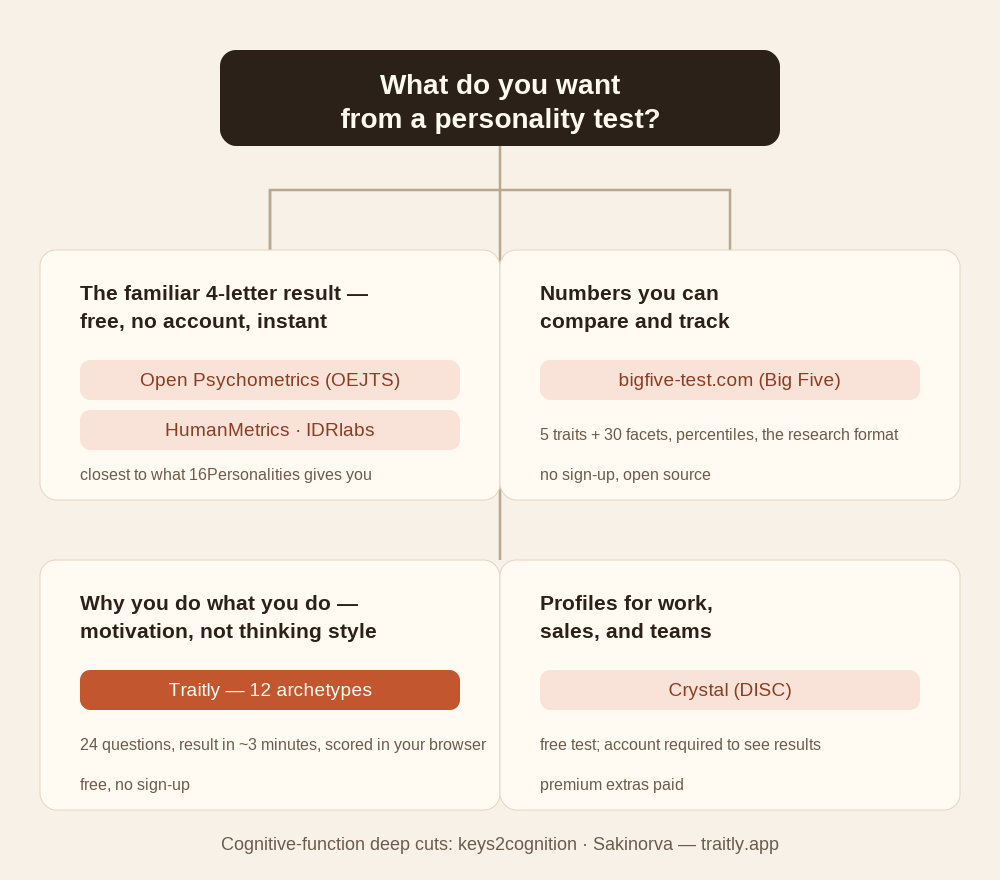
The honest ranking depends entirely on what you're after:
- Want the familiar four-letter result, free and without an account? Take the OEJTS, with HumanMetrics as the richer read.
- Want numbers you can compare, track, and trust? bigfive-test.com — that's the format psychology research uses.
- Want to understand what drives you? That's a motivation question — the archetype test answers it in 3 minutes. If you want a second lens on what pulls your choices, the 7 deadly sins test asks which desire leads you.
- Need profiles for work or a team? Crystal, with the caveat that it requires an account.
Is 16Personalities accurate? What the research says
Worth knowing before you pick: 16Personalities is not the official MBTI. Its own framework explainer describes a model that measures five trait spectrums — the Big Five approach — but reports them as 16 type identities plus an Assertive/Turbulent suffix. The letters sit on top of continuous scores.
That rounding is where the criticism lives. A review of MBTI research in Review of Educational Research documents that dichotomous type scores are unstable: someone near the middle of a dimension gets assigned wholly to one side, and retest studies find a substantial share of people change type within weeks (Pittenger, 1993). A 51/49 split becomes one letter — and two fairly different people can carry the same label.
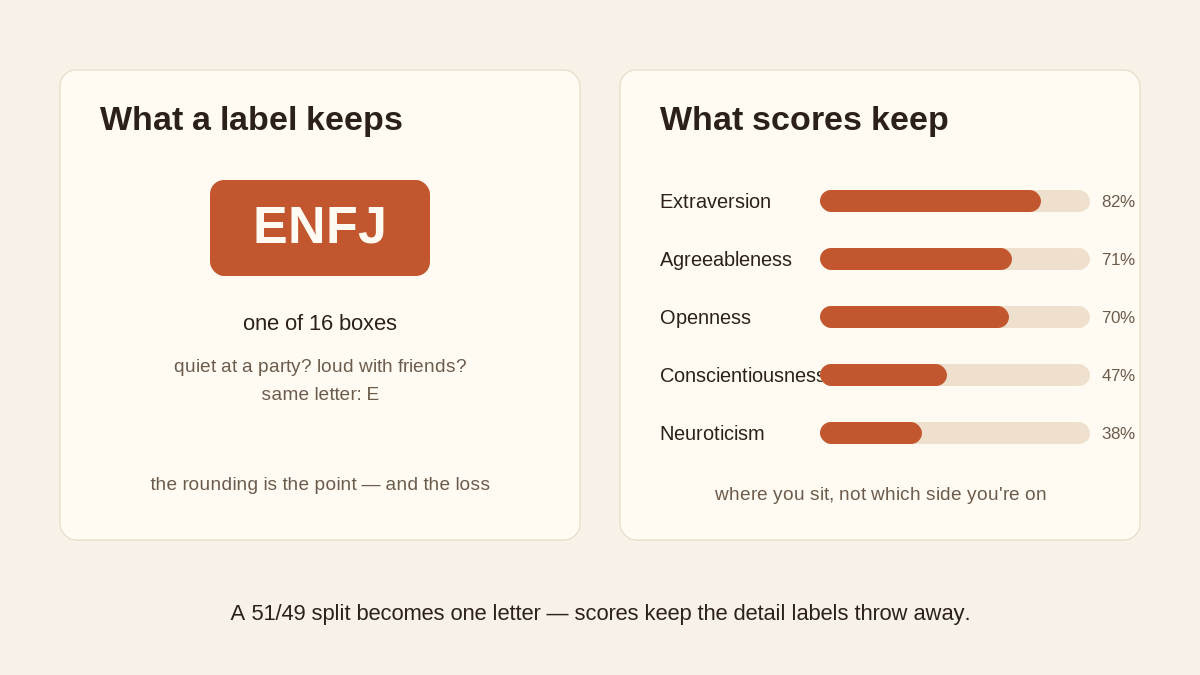
Trait models avoid the cliff: the five-factor model is validated across instruments and observers (McCrae & Costa, 1987), and its most common question bank is public domain. If you want measurement, that's the lane — bigfive-test.com above is the free version.
To be fair in the other direction: our own archetype test is also not a validated psychometric instrument. It's a structured, story-shaped lens built for the question trait scores don't answer — what motivates you. We say so on the page, and we explain how we build our tests. Use the right tool for the question you're actually asking.
Where 16Personalities still wins
Credit where it's due, because most "alternatives" posts won't say this part. 16Personalities' free tier is genuinely generous: a pleasant ten-minute test, a well-written multi-page profile for your type, and one of the largest personality communities on the internet. Taking it again is a perfectly good choice if what you want is exactly what it offers. Nothing on this list matches its reading experience — bigfive-test.com gives better numbers but less narrative; Traitly gives a different lens, not more depth. This article exists for the cases where it isn't the right fit: you want shorter, you don't want the upsell, you want real scores, or you want a framework that isn't letters.
The bottom line
If you remember one thing: match the test to your question. Letters for a shared vocabulary (OEJTS, HumanMetrics, IDRlabs), scores for measurement (bigfive-test.com), behavior at work (Crystal), motivation for the story you're actually living (Traitly's archetype test — 24 questions, 3 minutes, free, no sign-up).
Frequently asked questions
Is 16Personalities free?
Yes. The test and the basic profile of your type are free — 16Personalities makes money from paid premium profiles and Academy content. Creating an account is optional and only needed to save your results.
What is the closest free alternative to 16Personalities?
The Open Extended Jungian Type Scales (OEJTS) on Open Psychometrics: 60 items, completely free, no account, about 5–7 minutes, and an instant four-letter result with preference strengths — the same type system as 16Personalities. HumanMetrics' 72-question Jung Typology Test is the richest free read of the same kind.
Is 16Personalities actually the MBTI?
No. It's a proprietary model that measures five trait spectrums in the Big Five style, then reports them as 16 type identities plus an Assertive/Turbulent suffix. The official MBTI is a paid assessment usually administered through a certified practitioner.
Which is more accurate: 16Personalities or a Big Five test?
For measurement, the Big Five. 16Personalities rounds continuous trait scores into one of 16 labels, and a 51/49 split becomes one letter — two fairly different people can share a type. A full Big Five test like bigfive-test.com reports scores and facets, the format psychology research uses. Sixteen-type tests are better as a shared vocabulary than as a measurement.
Why do my results change between takes?
Because most type tests ask you toward the middle of each dimension, small shifts in mood or interpretation can flip you across a borderline. Research reviews of dichotomous type scores, such as Pittenger's 1993 review in Review of Educational Research, document exactly this retest instability. Continuous-score tests like the Big Five show it less dramatically.
Do any of these alternatives require sign-up?
Most don't: Open Psychometrics, bigfive-test.com, HumanMetrics, IDRlabs, keys2cognition, Sakinorva, and Traitly all show your result with no account and no email. Truity's account is optional (it saves your progress and results). Crystal is the exception — you must create a free account to see your results at all.